
Seller Credits vs. Price Cuts: A Smarter Way to Negotiate
A buyer comes back after inspection and asks for $10,000 off. The easy move is to just knock $10,000 off the price. Most agents do exactly that, on both sides of the table.
It's not always the best move for either side. Here's the math that usually gets skipped.
The two options aren't equal
A price cut lowers the loan amount. The buyer's payment drops a little, every month, for the life of the loan.
A seller credit can do the same thing, or it can be directed toward something more powerful: a temporary buydown, discount points, or the buyer's closing costs. Same dollar amount from the seller. Very different result for the buyer.
The actual numbers
Say the loan amount is $400,000 at a 6.75% 30-year fixed rate. Here's what $10,000 does, structured two different ways.
Option A: $10,000 off the price. The loan drops to $390,000. The buyer's principal and interest payment goes from $2,594 a month to $2,530 a month.
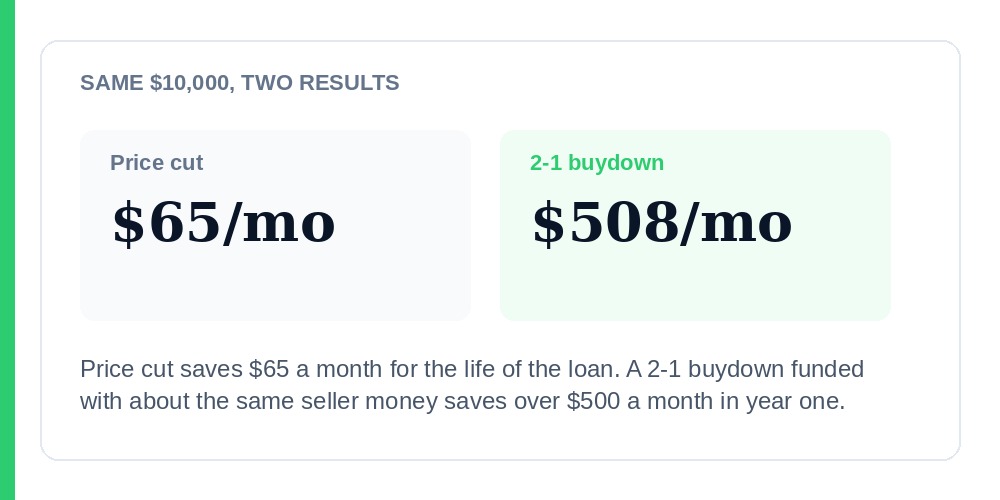
That's a savings of about $65 a month. For the life of the loan.
Option B: $10,000 credit toward a 2-1 temporary buydown. The loan stays at $400,000, but the rate is temporarily reduced. Year one runs at 4.75% instead of 6.75%, cutting the payment to about $2,087 a month. Year two runs at 5.75%, bringing it to about $2,334 a month. Year three and beyond, it reverts to the normal $2,594 payment.
That's a savings of about $508 a month in year one, and $260 a month in year two. Funding both years costs the seller roughly $9,200, close to the same $10,000 they'd have given up on a price cut.
Why the credit usually wins
Most buyers feel the squeeze hardest in year one. A price cut spreads relief so thin it barely registers on a monthly budget. A buydown puts real breathing room exactly where it's needed, then eases off as the buyer's finances catch up.
It's also often a wash for the seller. The dollar amount isn't dramatically different. What changes is how much good it does the buyer, which can be the difference between a deal that closes and one that doesn't.
The VA angle
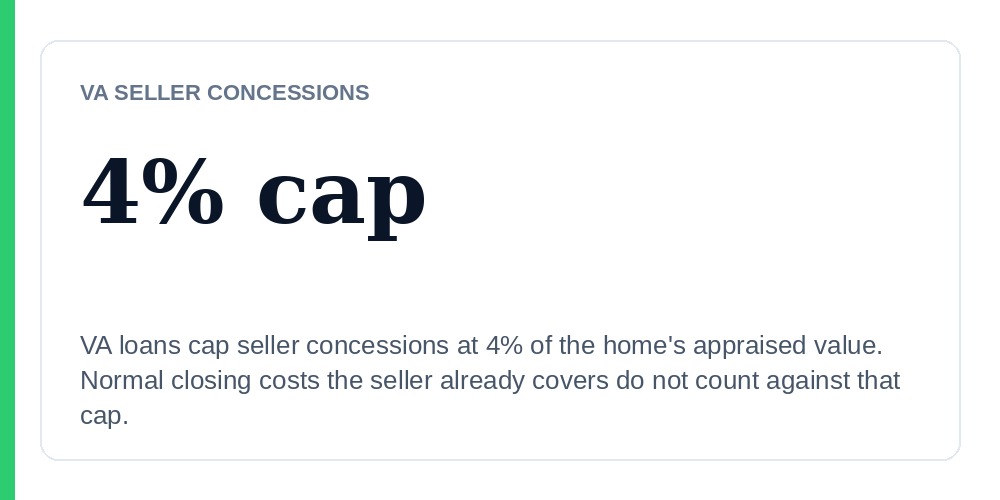
On a VA loan, buydown funds count as a seller concession, and VA concessions are capped at 4% of the home's appraised value. That's usually plenty of room on a typical buydown, but it's worth checking the math against the appraisal, not just the sale price, before you build a negotiation strategy around it. Normal closing costs the seller already covers don't count against that 4% cap.
When a straight price cut still makes more sense
A buydown is not always the right move. A few situations still favor a straight price cut instead.
The appraisal comes in low and the buyer needs the price reduced to make the loan work at all.
The buyer's debt-to-income ratio is tight, and a lower loan amount helps them qualify more than a temporary rate reduction would.
The buyer plans to refinance within a year or two, before a 2-1 buydown's second-year savings would even kick in.
Before you counter
Run the numbers on your specific offer before you decide which way to negotiate. Our buydown calculator shows the real monthly savings side by side with a straight price cut, or just call your Loan Officer and we'll run both scenarios for you.
Frequently Asked Questions
Is a seller credit the same thing as a price reduction?
No. A price reduction lowers the loan amount and saves the buyer a small amount every month for the life of the loan. A seller credit is cash that can be directed toward closing costs, discount points, or a temporary buydown, which usually delivers a much bigger payment reduction in the first year or two.
Can seller credits be used for anything the buyer wants?
No. Seller credits are limited to closing costs, prepaids, and buydown funds. They cannot be used toward the down payment or handed to the buyer as cash.
Is there a limit on seller credits for a VA loan?
Yes. VA loans cap seller concessions at 4% of the home's appraised value. Normal closing costs the seller already covers do not count against that cap, so most buydowns still fit comfortably inside it.
Does a temporary buydown cost the seller more than a straight price cut?
Usually not by much. In the example above, funding a 2-1 buydown cost about $9,200, close to the $10,000 price cut, but delivered over $500 a month in savings during year one instead of $65 a month for the life of the loan.
Expect to close one week early.